In the end, Nintendo
realized its blunder of forcing its Super NES Mortal Kombat
to go without the popular arcade elements when they received
angry letters not only from game fans but from parents who were
seeing Nintendo setting itself up as censors doing the job that
parents and free-minded individuals could have done on the
consumer level. Ultimately, this and the diminished sales
of the Super NES version (the Gameboy version is bad enough to
not make many mention of it in this article) led Nintendo a year
later to allow Acclaim to publish the arcade sequel Mortal
Kombat II for the Super NES with all its gruesome elements
intact, though it now came with a label that warned of such
content being in the game. With the Entertainment Software
Ratings Board system in place a year later, the issue of
censoring out violent material became moot.
Other Dishonorable Mentions
Philips CD-i Zelda games -- Philips
Electronics in the early half of the 1990s was given license
by Nintendo to develop games based on its licenses for the
CD-i multimedia system, which was intended to be the
technology that would power the SNES CD-ROM adapter. Although
the adapter was never worked on (except by its competitor
Sony, which was going to develop a standalone version called
the PlayStation), Philips did develop three games based on The
Legend Of Zelda game series. Two of these games, Link:
The Faces Of Evil and Zelda: The Wand Of Gamelon,
were side-scrolling adventures that had animated cutscenes
that told their individual stories, while Zelda's
Adventure was a top-down adventure with live-action
full-motion video cutscenes that was more reminiscent of the
first Legend Of Zelda game. Neither of these games are
remembered very fondly, with The Faces Of Evil and The
Wand Of Gamelon being greatly derided for their terrible
cutscene animation quality and voice acting. Nintendo itself
doesn't recognize these games as being part of the official
game series canon, which is the reason they don't appear in
any of the Hyrule Historia timelines.
Superman (Titus/Nintendo 64) -- In
all fairness, the Man of Steel is a rather difficult character
to make a videogame with, because his level of power and his
invulnerability to anything besides Kryptonite and magic means
that game developers have to tinker with the character to make
him workable. The first videogame he starred in, which was for
the Atari 2600, actually worked due to the limitations of the
system itself, making the game a rather fun, if also a short,
adventure into the world of Metropolis circa 1978. The
Nintendo 64 version, which was based on Warner Bros.
Animation's cartoon show of the same name in the 1990s,
following the success of Batman: The Animated Series,
was going to be his first foray in the world of 3D graphics
gaming, and it even had the same voice actors from the series
providing their talent. Unfortunately, Titus wasn't up to the
challenge of making the game fun, so what players got instead
was a Man of Steel that was barely controllable, playing a lot
of timed missions that were barely completable due to the bad
controls, many of which include having to fly through a series
of hoops without missing a single one. To make it worse, the Metropolis
in the game was always coated in a fog that was used in other
Nintendo 64 games to disguise the fact that the system
couldn't render incoming objects from a certain distance
without pop-up. Titus first covered this up by saying in-game
that Lex Luthor had covered Metropolis in a Kryptonite fog,
then later changed it so that the Metropolis that Superman was
flying in was actually a virtual reality recreation. None of
this stopped gamers from denouncing this as one of the worst
games ever made, but that didn't stop Infogrames from having a
shot of doing justice to the superhero license in its animated
format on the PlayStation 2 and the Nintendo GameCube.
Daikatana (Ion Storm/PC) -- John Romero,
one of the producers for Doom and Quake,
thought he could make a first-person shooter game that would
top his previous efforts, and so he founded the company known
as Ion Storm with the intent of creating that game. As early
on as 1997, readers of game magazines were treated to ads that
proclaimed "John Romero's About To Make You His Bitch", which
didn't announce the game, but set players' expectations for
what was soon to follow. John thought and promised gamers that
this was going to come out in 1998, but unfortunately it took
about three years to develop the game as Ion Storm ran into
development troubles, including a switch from one game engine
to another, that required its parent company to bail them out
of time and again, not to mention the rock-star life John
Romero was living during that time as its main office was more
of a gamer's paradise than it was a serious developer's studio.
By the time the game came out in 2000, it was clear that it
didn't live up to all the hype that surrounded it, as it ended
up having outdated graphics, terrible AI, frustrating
missions, very limited game saves, and embarrassing
early-level enemies such as mutated mosquitoes. It became the
game that killed Ion Storm and made John Romero's name a joke
in the gaming industry.
Enter The Matrix (Atari/GameCube,
PlayStation 2, Xbox, PC) -- Created as a tie-in to The
Matrix Reloaded, which was released in the same year
with The Matrix Revolutions following about six
months afterward, Enter The Matrix is a side-story
adventure featuring the characters of Ghost and Niobe running
through the world of the Matrix, fighting off Agent Smiths and
trying to stay alive to complete their objectives. Because the
game was rushed so that it could be released at the time The
Matrix Reloaded hit the theaters, it was plagued with
problems such as getting stuck on walls, texture problems, and
collision detection issues -- not to mention that you can
bypass an entire level of fighting Agent Smiths early in the
game simply by heading right at the start of the level instead
of left, as the game tells you.
Sonic The Hedgehog (Sega/PlayStation 3,
Xbox 360) -- To celebrate the franchise's 15th birthday
in 2006, Sega decided to reboot it with a 3D platform game
that was called, of course, Sonic The Hedgehog. To its
credit, the game introduced another rival to Sonic named Silver,
a hedgehog with telekinetic powers who
must contend with a mysterious evil doppelganger calling
itself "Mephiles The Dark", who seeks to activate "The Iblis
Trigger" and plunge the future into despair. Sadly, though,
the game got "Christmas rushed" out the door, so instead of
dealing with the issues that the 3D games like the Sonic
Adventures series had to deal with, such as the camera
and wonky controls and physics, this game just made them worse
while adding very long load times. The game managed to sell
well to be inducted into the Xbox 360 Platinum Hits line, but
fans of the game series still consider it one of the worst
entries.
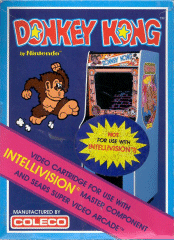 1. Donkey Kong
(Coleco/Intellivision) -- Prior to 1982, the
Intellivision's really big software-selling focus was on sports
games; having the best-looking, best-sounding, and overall
best-playing versions of baseball, football, basketball, soccer,
hockey, and whatever kind of sport they could emulate for the
hard-core sports-playing fan. Although Mattel didn't
ignore the arcade-action category of games completely, for they
had also released Astrosmash, Space Armada, Space
Hawk, Star Strike, and Night Stalker,
more people found that kind of gaming on the Atari 2600 and
found their games to be more enjoyable than their Intellivision
counterparts. Up until 1982, Mattel provided the bulk of
Intellivision's software support, but over time would also
accrue third-party developers such as Imagic, Activision,
Coleco, and even their rival Atari that would give their
neglected arcade-action game category a boost in titles.
Coleco, in particular, had the boldest marketing strategy of
supplying gameware for the Atari 2600 and Intellivision in
addition to their newly-released ColecoVision, and one of
their debut titles was a home rendition of Nintendo's classic
arcade game of 1981, Donkey Kong, for all three systems.
1. Donkey Kong
(Coleco/Intellivision) -- Prior to 1982, the
Intellivision's really big software-selling focus was on sports
games; having the best-looking, best-sounding, and overall
best-playing versions of baseball, football, basketball, soccer,
hockey, and whatever kind of sport they could emulate for the
hard-core sports-playing fan. Although Mattel didn't
ignore the arcade-action category of games completely, for they
had also released Astrosmash, Space Armada, Space
Hawk, Star Strike, and Night Stalker,
more people found that kind of gaming on the Atari 2600 and
found their games to be more enjoyable than their Intellivision
counterparts. Up until 1982, Mattel provided the bulk of
Intellivision's software support, but over time would also
accrue third-party developers such as Imagic, Activision,
Coleco, and even their rival Atari that would give their
neglected arcade-action game category a boost in titles.
Coleco, in particular, had the boldest marketing strategy of
supplying gameware for the Atari 2600 and Intellivision in
addition to their newly-released ColecoVision, and one of
their debut titles was a home rendition of Nintendo's classic
arcade game of 1981, Donkey Kong, for all three systems.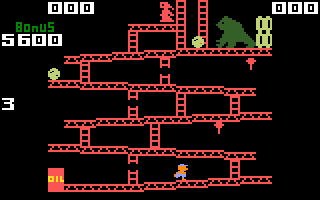 While I personally champion the idea of making
versions of a popular game available for multiple game systems,
one can only wonder what happened with the Intellivision port of
Donkey Kong that made people suspect that Coleco had
deliberately sabotaged the programming of that version in order
to make the ColecoVision version look better (the same criticism
which was also aimed at the 2600 version). First of all,
there are only two screens in this version -- the ramps and the
rivets -- and both of them look like the ColecoVision version's
done using those old honeycombed popsicle sticks that children
could build little houses and stuff from. Mario, his
girlfriend, and Donkey Kong look worse than they do on the 2600,
almost to the point of being unrecognizable. The sound
effects were a weak imitation of the arcade original's that also
included music, and the game's controls were barely responsive
enough to let Mario climb up and down these screens and jump
over the barrels and fireballs that were hurled down at him by
the crazy ape. Even having four skill levels and a one- or
two-player option added to this version wasn't enough to
exonerate this failure.
While I personally champion the idea of making
versions of a popular game available for multiple game systems,
one can only wonder what happened with the Intellivision port of
Donkey Kong that made people suspect that Coleco had
deliberately sabotaged the programming of that version in order
to make the ColecoVision version look better (the same criticism
which was also aimed at the 2600 version). First of all,
there are only two screens in this version -- the ramps and the
rivets -- and both of them look like the ColecoVision version's
done using those old honeycombed popsicle sticks that children
could build little houses and stuff from. Mario, his
girlfriend, and Donkey Kong look worse than they do on the 2600,
almost to the point of being unrecognizable. The sound
effects were a weak imitation of the arcade original's that also
included music, and the game's controls were barely responsive
enough to let Mario climb up and down these screens and jump
over the barrels and fireballs that were hurled down at him by
the crazy ape. Even having four skill levels and a one- or
two-player option added to this version wasn't enough to
exonerate this failure.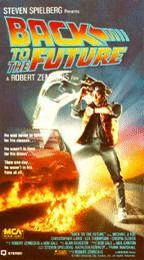 2. Back To The Future (LJN/NES) -- When
Nintendo revived the American market and interest in videogames
in the late 1980s, the company garnered enough help from
third-party software developers through its "quality assurance"
licensing system that would, in theory, prevent a repeat of the
market implosion of the mid-1980s from the uncontrolled glut of
games (most of them bad) that customers and sellers got swamped
with. In practice, however, it didn't entirely stop bad
games from coming out by companies whose goal was to make good
profits rather than good games. LJN, a formerly
independent toy company that became part of Acclaim, started out
in the NES game business with games based on popular movies such
as Jaws, Friday The 13th, Nightmare On Elm Street,
Beetlejuice, and The Karate Kid, with varying
degrees of quality. However, one particular specimen, an
adaptation of Universal's 1985 sci-fi/comedy Back To The
Future, repeated the same sin that E.T. The
Extra-Terrestrial had committed on the Atari 2600 -- the
sin of trying to market a game based on a great movie that
doesn't have anything that could be adequately turned into a
workable, let alone enjoyable, game experience.
2. Back To The Future (LJN/NES) -- When
Nintendo revived the American market and interest in videogames
in the late 1980s, the company garnered enough help from
third-party software developers through its "quality assurance"
licensing system that would, in theory, prevent a repeat of the
market implosion of the mid-1980s from the uncontrolled glut of
games (most of them bad) that customers and sellers got swamped
with. In practice, however, it didn't entirely stop bad
games from coming out by companies whose goal was to make good
profits rather than good games. LJN, a formerly
independent toy company that became part of Acclaim, started out
in the NES game business with games based on popular movies such
as Jaws, Friday The 13th, Nightmare On Elm Street,
Beetlejuice, and The Karate Kid, with varying
degrees of quality. However, one particular specimen, an
adaptation of Universal's 1985 sci-fi/comedy Back To The
Future, repeated the same sin that E.T. The
Extra-Terrestrial had committed on the Atari 2600 -- the
sin of trying to market a game based on a great movie that
doesn't have anything that could be adequately turned into a
workable, let alone enjoyable, game experience.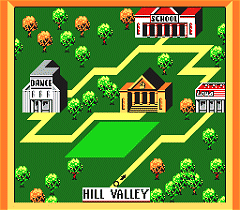
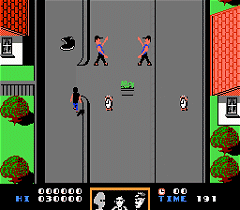
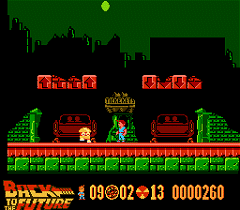 Being one that bought LJN's combined adaptation of the movie
sequels, Back To The Future II & III, around 1990
for my birthday, I was treated to a game that made more sense as
a movie adaptation (Marty did more time-traveling in Back To
The Future Part II and Part III than he did in the
original) and yet also came off as a really long and
not-quite-entertaining imitation of the Super Mario Bros.
games, even with creatures that looked like they were inspired
from those games. I didn't even try to get through the
Part II section of the game until I had a third-party
game-cheating device called the Game Action Replay on my NES to
let me save my position in the game, and Part III looks like it
wasn't finished in time since it had mini-games like in the Part
II section that had some really difficult challenges that made
me suspect that this product had to go to market even after LJN
originally scrapped the idea of releasing it as Back To The
Future Part II in order to fit the Part III section in.
Being one that bought LJN's combined adaptation of the movie
sequels, Back To The Future II & III, around 1990
for my birthday, I was treated to a game that made more sense as
a movie adaptation (Marty did more time-traveling in Back To
The Future Part II and Part III than he did in the
original) and yet also came off as a really long and
not-quite-entertaining imitation of the Super Mario Bros.
games, even with creatures that looked like they were inspired
from those games. I didn't even try to get through the
Part II section of the game until I had a third-party
game-cheating device called the Game Action Replay on my NES to
let me save my position in the game, and Part III looks like it
wasn't finished in time since it had mini-games like in the Part
II section that had some really difficult challenges that made
me suspect that this product had to go to market even after LJN
originally scrapped the idea of releasing it as Back To The
Future Part II in order to fit the Part III section in.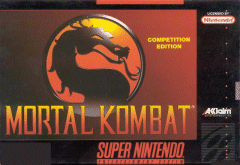 3. Mortal Kombat (Acclaim/Super NES) --
Competing against Capcom's Street Fighter II in the
arcades was Midway's own one-on-one fighting game which featured
not only digitized actors playing the various fighting
characters in the game (a technique used previously with Atari
Games' Pit Fighter), but over-the-top blood spews when
certain hits are used and gruesome finishing moves better known
as "fatalities" that could be activated by entering in a
controller code at the right time when the player beats his
opponent in two rounds. The game's notoriety would also
make Mortal Kombat a target for parent groups who decry
the increasingly-graphic visuals in all forms of entertainment
as a sign of American society's increasing downfall -- so much
so that it had affected the release of the game for home use on
the Super NES and Genesis systems.
3. Mortal Kombat (Acclaim/Super NES) --
Competing against Capcom's Street Fighter II in the
arcades was Midway's own one-on-one fighting game which featured
not only digitized actors playing the various fighting
characters in the game (a technique used previously with Atari
Games' Pit Fighter), but over-the-top blood spews when
certain hits are used and gruesome finishing moves better known
as "fatalities" that could be activated by entering in a
controller code at the right time when the player beats his
opponent in two rounds. The game's notoriety would also
make Mortal Kombat a target for parent groups who decry
the increasingly-graphic visuals in all forms of entertainment
as a sign of American society's increasing downfall -- so much
so that it had affected the release of the game for home use on
the Super NES and Genesis systems.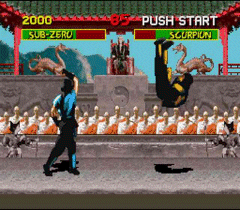 Nintendo
and Sega, the parent companies of the respectively mentioned
game systems, were of two different mindsets concerning Acclaim
releasing Mortal Kombat for their systems.
Nintendo had such a way with game companies to not only keep
their Super NES and Gameboy releases "family-friendly" and
"kid-friendly", but also to keep them as non-offensive as
possible, which included the alteration of a graphic still shot
of a gravestone in Super Castlevania IV by removing a
cross that adorned it. With Mortal Kombat, the
game was graphically altered by not only replacing the blood
spews with sweat, but also by altering some of the character's
finishing moves (the decapitation that Johnny Cage would inflict
upon his beaten opponent, for example, would be changed over
into a super-powerful kick that went straight through his
opponent's body -- gruesome enough, but rather tame in
comparison). While the Super NES version admittedly looked
better than its Genesis counterpart, Sega had won over
prospective buyers by allowing Acclaim to keep the blood and
finishing moves intact in its Genesis release -- yet in order to
see this in all its gory...I mean, glory...the player had to
enter in a controller code at a certain point in one of the
game's introduction screens talking about "codes". The
same thing was also done with the Game Gear version of Mortal
Kombat, keeping the arcade-rich elements hidden and only
accessible through a controller code.
Nintendo
and Sega, the parent companies of the respectively mentioned
game systems, were of two different mindsets concerning Acclaim
releasing Mortal Kombat for their systems.
Nintendo had such a way with game companies to not only keep
their Super NES and Gameboy releases "family-friendly" and
"kid-friendly", but also to keep them as non-offensive as
possible, which included the alteration of a graphic still shot
of a gravestone in Super Castlevania IV by removing a
cross that adorned it. With Mortal Kombat, the
game was graphically altered by not only replacing the blood
spews with sweat, but also by altering some of the character's
finishing moves (the decapitation that Johnny Cage would inflict
upon his beaten opponent, for example, would be changed over
into a super-powerful kick that went straight through his
opponent's body -- gruesome enough, but rather tame in
comparison). While the Super NES version admittedly looked
better than its Genesis counterpart, Sega had won over
prospective buyers by allowing Acclaim to keep the blood and
finishing moves intact in its Genesis release -- yet in order to
see this in all its gory...I mean, glory...the player had to
enter in a controller code at a certain point in one of the
game's introduction screens talking about "codes". The
same thing was also done with the Game Gear version of Mortal
Kombat, keeping the arcade-rich elements hidden and only
accessible through a controller code.